
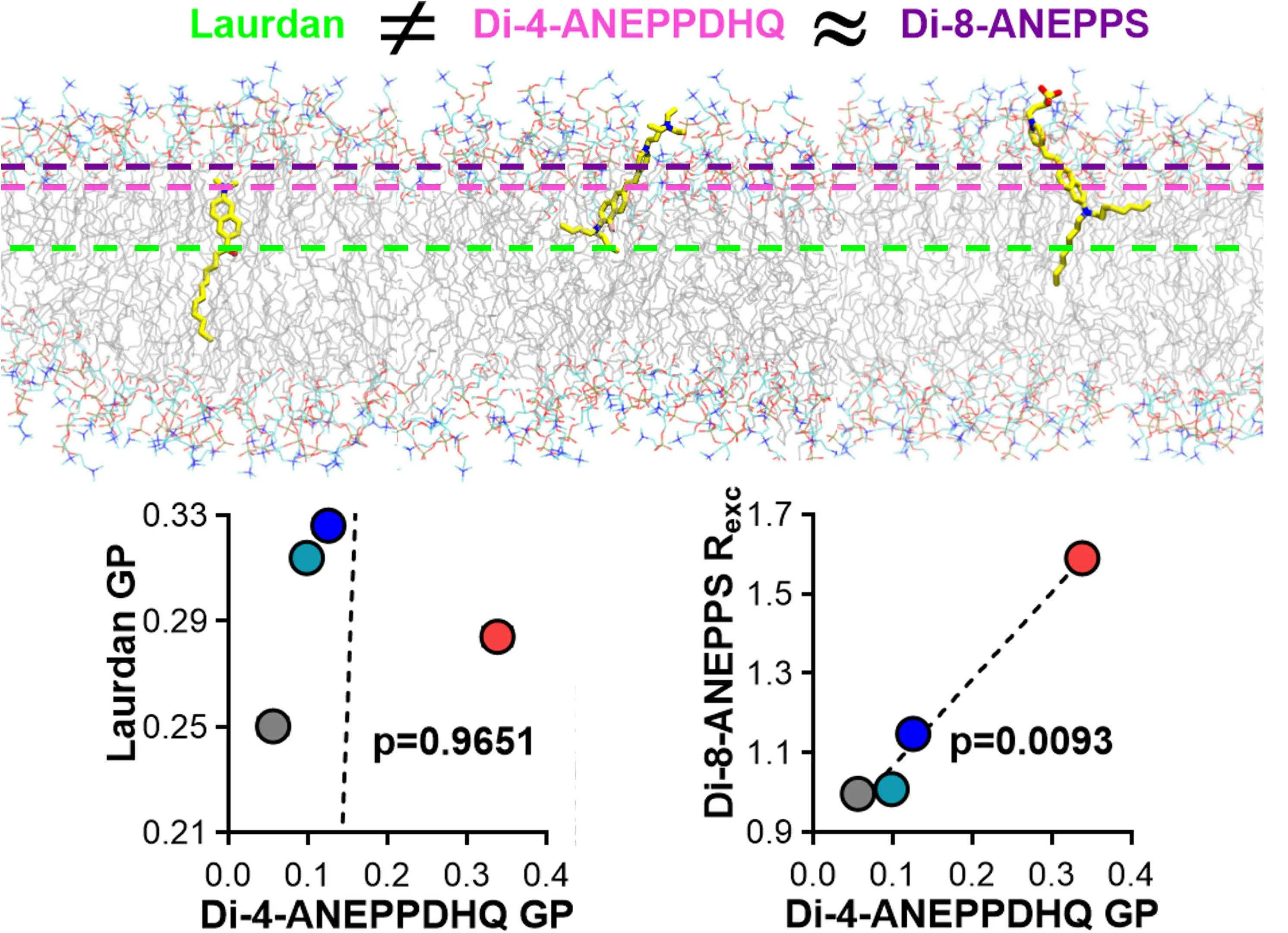
 The composition and molecular order of the cell membrane play key roles in regulating the function of membrane proteins. In living cells, structural organization of the membrane is generally characterized by three parameters (dipole potential, fluidity, and hydration), which can be studied using fluorescence-based methods and fluorophores sensitive to environmental parameters. Among these dyes, Laurdan is the most commonly used compound, as its emission spectrum shifts depending on the hydrophobicity of the local microenvironment (quantified by the fluorophore’s so-called generalized polarization), meaning that it is sensitive to membrane hydration, but its application is hindered by its unfavorable spectral properties. Due to its more favorable spectral characteristics, Di-4-ANEPPDHQ can be easily applied in conventional imaging techniques and is generally regarded in the literature as a functional alternative to Laurdan. However, given the structural differences between the two dyes, the question arises as to whether they can truly be considered equivalent.
In their latest publication, Dr. Tamás Kovács, Dr. Florina Zákány, and their colleagues modified the composition of the plasma membranes of living cells using various sterols (cholesterol, 7-dehydrocholesterol, 6-ketocholestanol) precomplexed with methyl-beta-cyclodextrin, and through measurements carried out using spectrofluorometry and confocal microscopy, they found that the treatments affected the generalized polarization of Laurdan and Di-4-ANEPPDHQ in a distinct manner. In contrast, the differences observed in the latter correlated much more strongly with changes in the excitation ratio of another environment-sensitive fluorophore, the dipole-potential-sensitive Di-8-ANEPPS. The authors demonstrated via molecular dynamics simulations that this is because Di-4-ANEPPDHQ - similarly to Di-8-ANEPPS - is located near the membrane-water interface within the membrane, whereas Laurdan is found in deeper, hydrophobic regions. Therefore, contrary to the generally accepted view in the literature, Di-4-ANEPPDHQ cannot be considered a functional alternative equivalent to Laurdan in membrane biophysical studies, as it is much more similar to Di-8-ANEPPS.
The study was published in the Journal of Physical Chemistry Letters.
Rosemary Chandrakanthi Kothalawala, Csenge Makay, Lajos Szente, Zoltán Varga, György Panyi, Péter Nagy, Florina Zákány*, Tamás Kovács*
DOI: 10.1021/acs.jpclett.6c00048
A detailed investigation of the generalized polarization of Di-4-ANEPPDHQ
Laurdan and Di-4-ANEPPDHQ characterize molecular organization of the cell membrane at different depths.
Last update:
2026. 05. 13. 16:20