
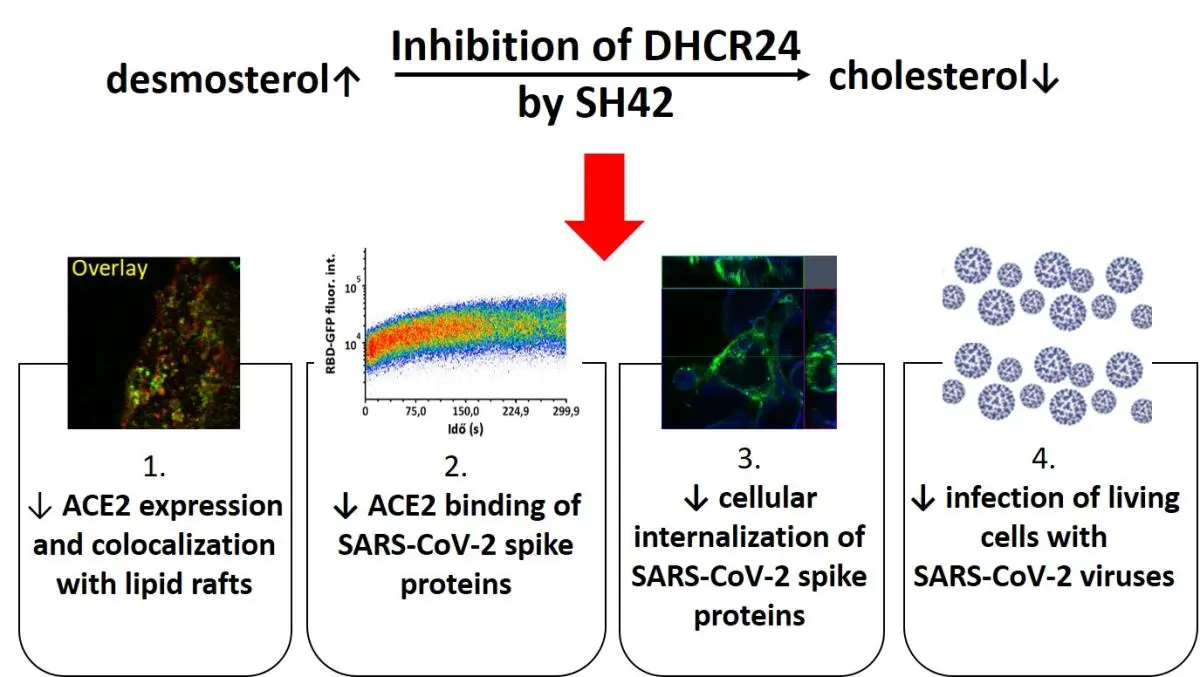
 The first and most critical step of SARS-CoV-2 infection is the binding of the viral spike proteins to ACE2, which is strongly dependent on the cholesterol content of the host cell membrane. For this reason, reducing the membrane cholesterol level in pulmonary epithelial cells — one of the primary entry points of the virus — may exert a preventive effect against viral infection and complement other specific antiviral strategies, such as vaccination, which are prone to the development of resistance.
Florina Zákány and her colleagues investigated the role of the recently described synthetic sterol analogue SH42 in SARS-CoV-2 infection and compared its effects with atorvastatin —the most commonly used cholesterol synthesis inhibitor in hypercholesterolemia. SH42 selectively inhibits the terminal step of de novo cholesterol synthesis by targeting the DHCR24 enzyme, and therefore may have fewer side effects than atorvastatin. Using flow cytometry and three-dimensional confocal microscopy, the authors compared the effects of SH42 and atorvastatin (both used at clinically relevant concentrations) on membrane cholesterol and lipid raft content, the level of cell surface ACE2 expression, as well as the binding of spike proteins from various SARS-CoV-2 variants to the ACE2 receptor and their entry into pulmonary epithelial cells. Finally, they compared the effects of the treatments on cellular infection by living, replication-competent viruses, which was quantified by determining viral RNA copy numbers.
Their results revealed that SH42, a novel cholesterol biosynthesis inhibitor targeting the DHCR24 enzyme effectively inhibited the early, membrane-coupled steps of SARS-CoV-2 infection, primarily by disrupting lipid rafts and reducing cell surface ACE2 expression. This was also reflected in the effective inhibition of cellular infection, as indicated by reduced viral RNA copy numbers within cells following infection with living viruses. Compared to the reference drug atorvastatin, SH42 demonstrated greater efficacy and stronger inhibitory activity in all examined parameters. The pioneering nature of their findings lies in the fact that this is the first demonstration that a new class of cholesterol synthesis inhibitors targeting the DHCR24 enzyme, such as SH42, may represent a promising approach in the prevention and adjuvant therapy of COVID-19.
This study was published in Research - A Science Partner Journal.
Tamas Kovacs*, Kitti Kurtan*, Bernadett Pályi, Zoltán Kis, Mohamed Mahdi, Jesús Borrego, József Tőzsér, Zoltan Varga, Peter Nagy, Gyorgy Panyi, Florina Zakany
DOI: 10.34133/research.1280