
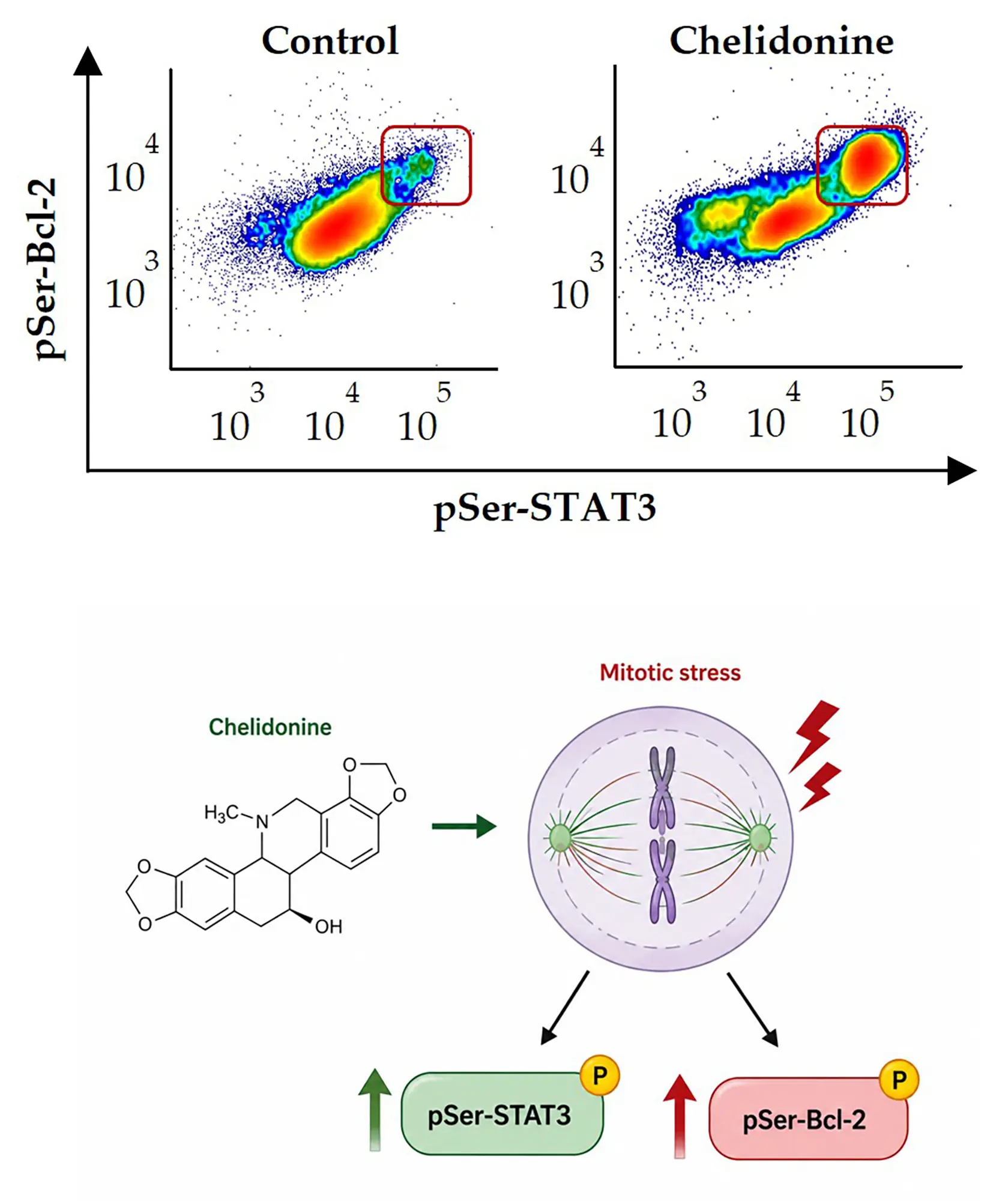
 Chelidonine, the major alkaloid of Chelidonium majus L., has shown promising anticancer activity. In our earlier work, we found that it can influence STAT3, a transcription factor regulating several genes involved in cell survival, including Bcl-2. Both STAT3 and Bcl-2 contain serine phosphorylation sites that have roles during mitosis.
In this study, we examined how chelidonine affects these phosphorylation events in human T-cell leukemia/lymphoma cells. Using single-cell analysis, we identified a distinct subpopulation of cells showing a transient increase in serine-phosphorylated STAT3, accompanied by Bcl-2 phosphorylation at Ser70 and a parallel increase in detectable Bcl-2 levels. These changes occurred in almost exactly the same cells and were tightly linked to the M phase of the cell cycle, as indicated by mitotic nuclear morphology. The response was also observed in the absence of IL-2, suggesting that chelidonine acts independently of the classical cytokine-driven STAT3 pathway.
Our results provide single-cell evidence that chelidonine induces coordinated serine phosphorylation of STAT3 and Bcl-2 during mitosis. Because both proteins contribute to cellular stress responses during cell division, this transient signaling pattern may help explain how cancer cells respond to mitotic stress, and may point to new ways of targeting STAT3- and Bcl-2-related pathways in cancer therapy. (Baddour et al., Int J Mol Sci, 2026, 27:1200. doi: 10.3390/ijms27031200.)