
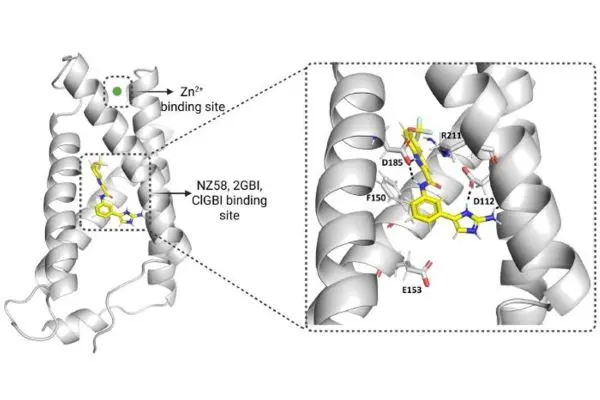
 A recent publication by our research team has introduced a novel group of inhibitors of the voltage-gated proton channel hHv1, the 5-phenyl-2-aminoimidazoles. To guide rational drug design of selective derivatives, our goal was to map the molecular mechanism of compound 13 (i.e., NZ-58), a potent member of the series. For this, we utilized site-directed mutagenesis and conventional patch-clamp technique. Applying NZ-58 at various membrane potentials, and using different pulse frequencies, we could unveil the binding mode, which showed closed-state inhibition and no use dependence. The changes in inhibition of mutated hHv1 constructs confirmed the binding pocket suggested by molecular docking comprising countercharges D112 and D185. Combining the results of ionic and gating current measurements revealed an interesting molecular mechanism that traps the S4 helix. Knowing the interacting partners of NZ-58, this mechanism aligned well with previously found functional models of hHv1. By integrating pharmacological and biophysical perspectives, this work lays the groundwork for future advancements in rational drug design.
A kinetic trap mechanism underlies hHv1 inhibition by NZ-58
Adam Feher, Geraldo Jorge Domingos, Martina Piga, Tihomir Tomašič, Nace Zidar,
J Gen Physiol (2026) 158 (4): e202513945.