
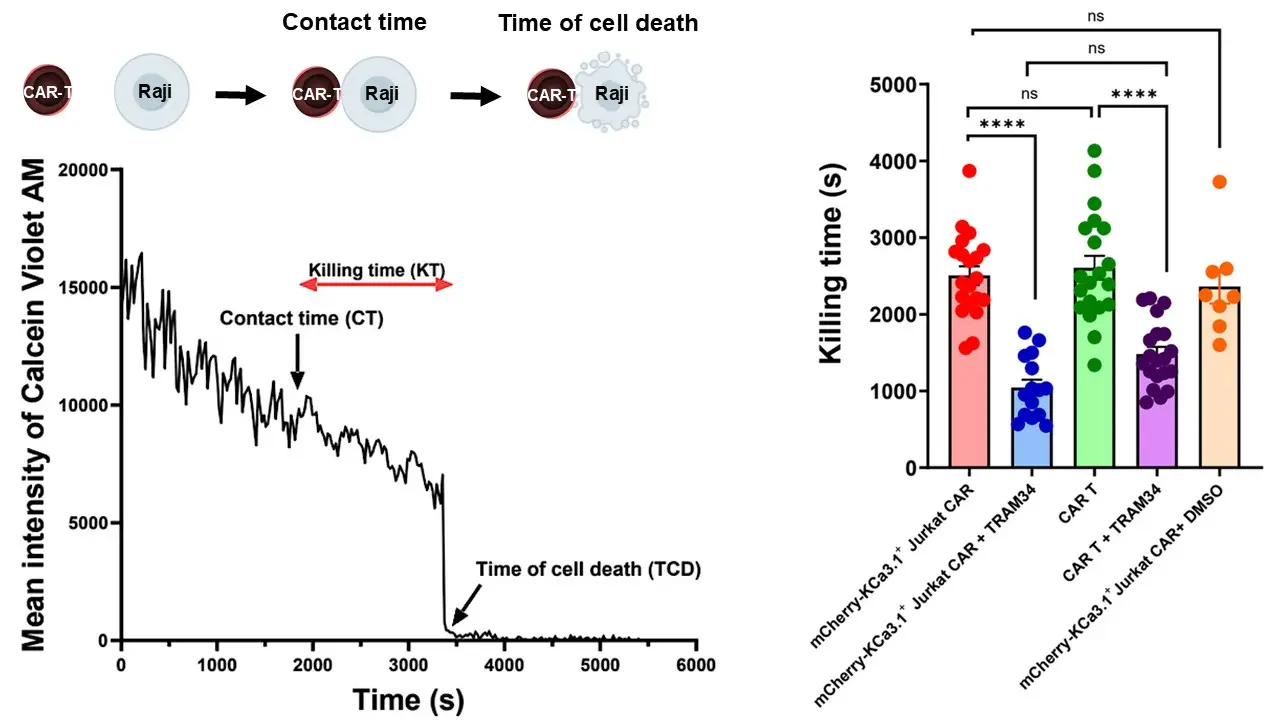
 Vivien Jusztus, Péter Hajdu and his colleagues investigated the role of KCa3.1 ion channels in CAR-T cell migration and tumor cell elimination. T cells with chimeric antigen receptor (CAR-T cells), created by genetically modifying T cells, are able to recognize the specific antigen in the tumor cell membrane and terminate the tumor. KCa3.1 potassium channels of T lymphocyte regulate several effector functions, such as cytokine release, migration and even target cell elimination via shaping the intracellular Ca2+ signaling. Several CAR cell lines (from Jurkat T-cell line and primary T-cells) have been generated that recognize the CD19 antigen on the surface of Raji B cells (served as target cells). Firstly, they showed that the functional expression of KCa3.1 in Jurkat-CAR cells (they have no endogenous KCa3.1) facilitated target cell elimination, interestingly block of KCa3.1 with TRAM34 (a specific KCa3.1 inhibitor) further increased killing efficiency of KCa3.1-expressing Jurkat-CARs. Secondly, as expected, introduction of KCa3.1 speeded up migration of KCa3.1+ Jurkat CARs (increased mean speed), while blockage of KCa3.1 increased displacement and total distance, but did not lower mean speed. The application of TRAM34 also lowered the baseline Ca2+-level in KCa3.1+ Jurkat CARs. Finally, TRAM34 significantly reduced the time needed to eliminate tumor cells and increased the frequency of CAR-cell – target cell encounter formation. We concluded that expression and modification of KCa3.1 ion channels shifts the intracellular Ca2+ concentration into the range where cytotoxicity dominates. Hence, modification of KCa3.1 channels could enhance anti-tumor efficacy of CAR T cells.
The results of the study were published in The Journal of Immunology.