
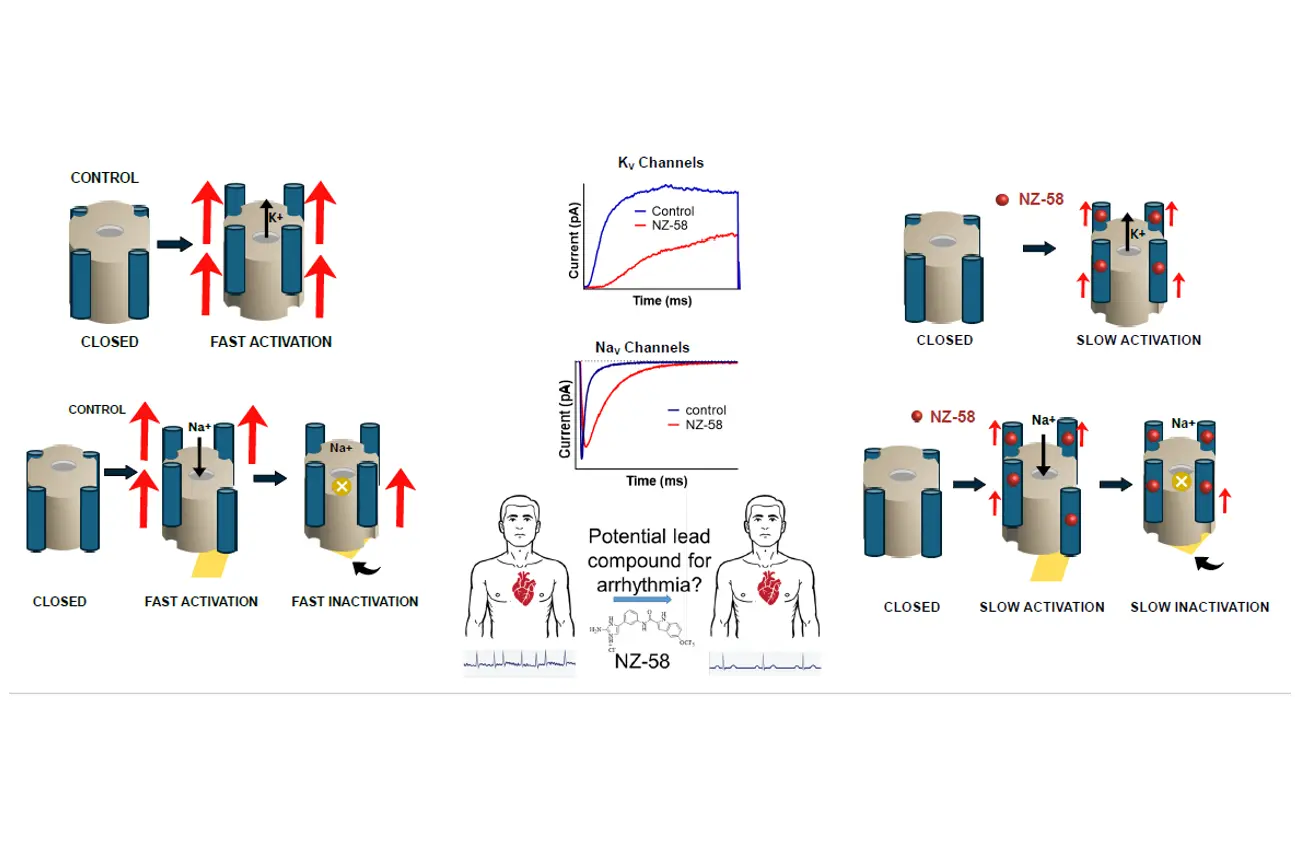
 We have identified NZ-58, a small-molecule, which potently blocked voltage-gated Na+ and K+ channels, but not the non-voltage-gated ones, suggesting an interaction with the voltage-sensor domains (VSDs). At lower concentrations (0.5–10 μM), it altered gating kinetics with minimal amplitude changes. NZ-58 significantly slowed the current activation kinetics of the channels, as well as the VSD-linked fast inactivation of the NaV1.5 channel, thereby substantially increasing total charge transfer. The loss-of-function Brugada mutant NaV1.5-R1632C was similarly enhanced by NZ-58, but the effect was not present on slowly inactivating KV channels. NZ-58 was able to bind to the channels in the closed state, not requiring the activated conformation of the VSDs, and it could exert its effects when applied from either side of the membrane.
Although non-selective, its unique VSD interactions and potential as a multi-target modulator make NZ-58 worthy of further investigation as a prospective ion channel modulator lead compound to be developed into an anti-arrhythmic agent acting via NaV1.5.
Domingos, G. J., Fehér, Á., Teshome, R. T., Husain, S., Papp, F., Amna, A. O., Bangera, K. C., Vizi, Z., Elian, R., Kovács, Z. M., Szentandrássy, N., Piga, M., Tomasic, T., Zidar, N., Varga, Z.: A small molecule voltage-sensor modulator enhances the function of the cardiac NaV1.5 channel.
Biomed. Pharmacother. 200, 1-14, (article identifier: 119530), 2026.
https://doi.org/10.1016/j.biopha.2026.119530